




- Get Well
- Best Sellers
- Under $60
 $54.90
- $54.90
- $79.90
- $54.90
- $49.90
- $49.90
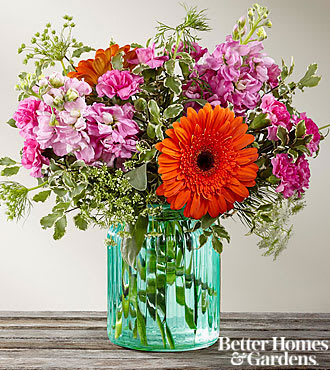
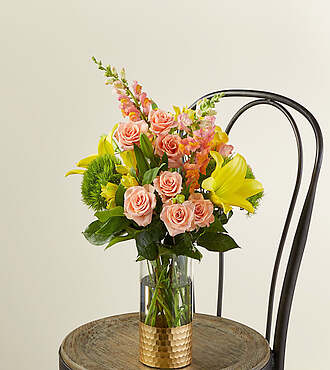
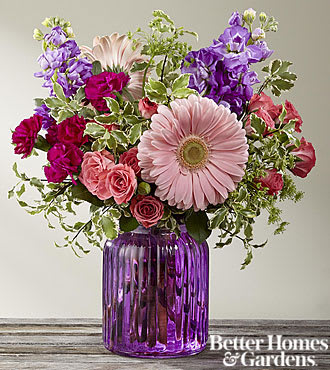
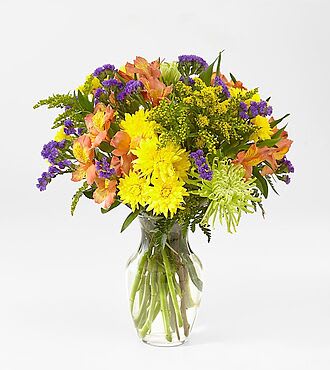


- $49.90

July 1, 2026
Mayville July Floral Selection
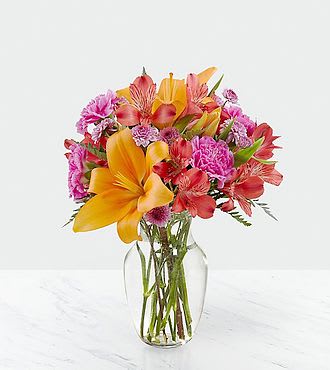
The Bloom Central flower delivery of the month for July in Mayville is the Be Bold Bouquet by Better Homes and Gardens

Introducing the Be Bold Bouquet by Better Homes and Gardens floral arrangement! Blooming with bright colors to boldly express your every emotion, this exquisite flower bouquet is set to celebrate. Hot pink roses, purple Peruvian Lilies, lavender mini carnations, green hypericum berries, lily grass blades, and lush greens are brought together to create an incredible flower arrangement.
The flowers are artfully arranged in a clear glass cube vase, allowing their natural beauty to shine through. The lucky recipient will feel like you have just picked the flowers yourself from a beautiful garden!
Whether you're celebrating an anniversary, sending get well wishes or simply saying 'I love you', the Be Bold Bouquet is always appropriate. This floral selection has timeless appeal and will be cherished by anyone who is lucky enough to receive it.
Better Homes and Gardens has truly outdone themselves with this incredible creation. Their attention to detail shines through in every petal and leaf - creating an arrangement that not only looks stunning but also feels incredibly luxurious.
If you're looking for a captivating floral arrangement that brings joy wherever it goes, the Be Bold Bouquet by Better Homes and Gardens is the perfect choice. The stunning colors, long-lasting blooms, delightful fragrance and affordable price make it a true winner in every way. Get ready to add a touch of boldness and beauty to someone's life - you won't regret it!
Local Flower Delivery in Mayville
Mayville Flower Delivery - Frequently Asked Questions
- Does Bloom Central offer same-day flower delivery in Mayville?
- Yes. Place your order online before 1:00 PM and a local Mayville florist will hand-deliver your arrangement the same day. Orders can also be scheduled up to one month in advance.
- Is it safe to order flowers online?
- Absolutely! We utilize a secure, encrypted checkout to protect your personal and payment information. Visa, Mastercard, American Express, Discover, PayPal and Klarna are all accepted.
- What hospitals and care facilities does Bloom Central deliver to in Mayville?
- We deliver fresh flower arrangements to all hospitals, nursing homes and care facilities in Mayville Wisconsin, including: Touchstone Of Mayville.
- What funeral homes does Bloom Central deliver sympathy flowers to in Mayville?
- We hand-deliver sympathy and memorial floral arrangements to all funeral homes near Mayville, including: Becker Ritter Funeral Home & Cremation Services, Church & Chapel Funeral Service, Feerick Funeral Home, Gunderson Funeral & Cremation Care, Koepsell-Murray Funeral Home, Konrad-Behlman Funeral Homes, Krause Funeral Home & Cremation Services, Nitardy Funeral Home, Nitardy Funeral Home, Olsen Funeral Home, Peace of Mind Funeral & Cremation Services, Phillip Funeral Homes, Poole Funeral Home, Randle-Dable-Brisk Funeral Home, Schmidt & Bartelt Funeral & Cremation Services, Schmidt & Bartelt Funeral & Cremation Services, Wachholz Family Funeral Homes, Zwaska Funeral Home.
- What nearby cities does Bloom Central also deliver flowers to?
- In addition to Mayville, we deliver fresh flowers to many nearby cities including: Theresa, Horicon, Hubbard, Leroy, Lomira, Juneau, Wayne, Allenton
- What are the most popular flower arrangements at the Mayville florist?
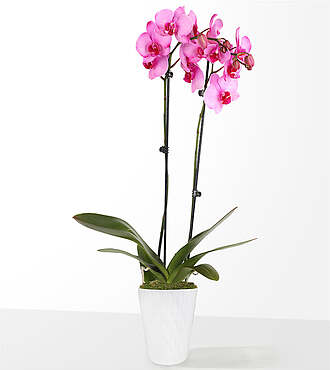
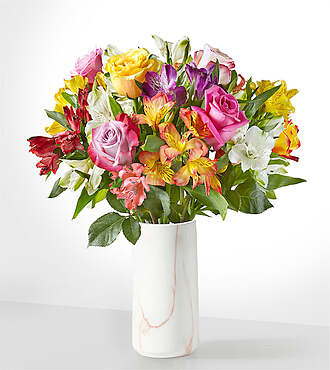
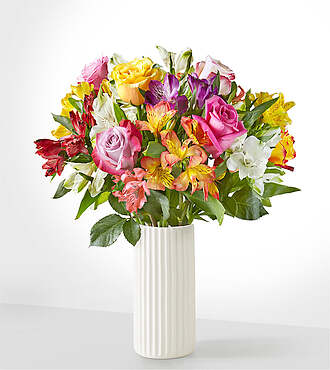
- Three of our most popular arrangements at our Mayville florist are: Pink Colored Florist Designed Bouquet ($49.90), Teahouse Bouquet ($64.90), Amber Muse Bouquet ($49.90). All are available for same-day delivery.
More About Mayville
Are looking for a Mayville florist because you are not local to the area? If so, here is a brief travelogue of what Mayville has to offer. Who knows, perhaps you'll be intrigued enough to come visit soon, partake in some of the fun activities Mayville has to offer and deliver flowers to your loved one in person!
Mayville, Wisconsin, sits in the kind of Midwestern geography that feels both accidental and inevitable, a place where the Rock River bends as if to cradle the town, where the sky opens itself into a blue so vast it suggests the ceiling of some grand civic hall. To drive into Mayville is to pass through a sequence of thresholds: first the fields, quilted with corn and soy, then the outskirts where homes wear their histories in Victorian eaves and wraparound porches, then the quiet pulse of downtown, where the buildings, limestone and brick, stand with the patient posture of elders who’ve seen cycles of boom and frost and still believe in the promise of spring. The air here carries the scent of mowed grass and freshwater, a combination that bypasses nostalgia and goes straight to the nervous system, a primal signal that you’ve arrived somewhere specific, a somewhere that matters.
The people of Mayville move through their days with a rhythm that feels both deliberate and unhurried, a paradox that might baffle coastal minds. At Berndt’s Café, the regulars cluster at laminate tables, not because they lack anywhere to be but because the act of being there, trading weather reports, dissecting high school football prospects, sipping coffee that’s been perfecting its recipe since Truman, is its own kind of work, a maintenance of communal bonds. Down at River Park, children pedal bikes along paths that follow the river’s curve, their laughter mingling with the clang of the ice cream truck’s anthem, while retirees cast fishing lines into water that mirrors the sky, their patience a quiet argument against the national cult of urgency.

Same day service available. Order your Mayville floral delivery and surprise someone today!
What’s easy to miss, if you’re just passing through, is how much the town’s identity is stitched to the land itself. The Horicon Marsh, a short drive east, is a sprawling testament to preservation, a wetland where herons stalk the shallows and sandhill cranes perform their gawky ballets. Locals speak of the marsh not as a tourist attraction but as a neighbor, something alive and breathing, a entity that teaches lessons about resilience, how to bend without breaking during floods, how to bloom riotously after drought. Back in town, the Mayville Limestone School Museum stands as a fossilized hymn to the region’s bedrock, its walls literal slabs of history, each fossilized ripple and shell a reminder that this place was once ocean floor, that change is both catastrophic and ordinary.
There’s a particular magic to the way Mayville honors continuity without fossilizing. The same family names appear on shop signage and mailboxes, generation after generation, but the library hosts coding workshops for kids. The annual Christmas parade still features tractors draped in tinsel, but the community center offers yoga classes where newcomers and lifelong residents stretch toward common ground. At the farmers’ market, held each Saturday in the shadow of the courthouse clock tower, you can buy honey bottled from backyard hives and heirloom tomatoes still warm from the vine, but you’ll also find a teenager selling graphic tees that say “Mayville: Middle of Nowhere, Heart of Everything” in a font that’s half-ironic, half-earnest, wholly true.
To spend time here is to sense a pattern, a lattice of connections that hold the place together. The high school football coach also teaches chemistry, and his halftime speeches are said to include metaphors about covalent bonds. The woman who runs the flower shop can tell you which perennials survive the frost because her grandmother told her, just as she’ll tell you, unprompted, that the best sunsets happen in February, when the cold sharpens the colors into something that feels like a shared secret. Even the river, which has carved this valley over millennia, seems to flow with a sense of purpose, as if it, too, understands its role in the ecosystem, not as a postcard backdrop but as a life source, a mirror, a thing that gives the town its shape and receives a shape in return.
It would be easy to label Mayville quaint, to reduce it to a stereotype of heartland simplicity. But that’s a failure of attention. This is a place that thrives on subtleties, on the unspoken pact between past and present, on the understanding that a community is not a static thing but a verb, an ongoing act of care. You notice it in the way people wave at passing cars regardless of whether they recognize the driver, in the way the diner’s pie case is always full but never too full, in the way the streetlights click on at dusk like a string of steady, reliable stars. The beauty here isn’t loud. It doesn’t need to be. It’s in the soil, in the water, in the habit of looking out for one another, a beauty that knows its worth without insisting you notice. But you will. You do.