





- Anniversary
- Best Sellers
- Sympathy
 $69.90




- $297.90
- $64.90





July 1, 2026
Raymond July Floral Selection
The Bloom Central flower delivery of the month for July in Raymond is the Love is Grand Bouquet
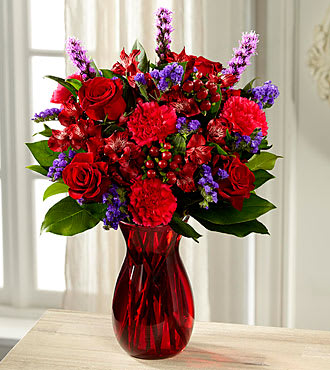
The Love is Grand Bouquet from Bloom Central is an exquisite floral arrangement that will make any recipient feel loved and appreciated. Bursting with vibrant colors and delicate blooms, this bouquet is a true showstopper.
With a combination of beautiful red roses, red Peruvian Lilies, hot pink carnations, purple statice, red hypericum berries and liatris, the Love is Grand Bouquet embodies pure happiness. Bursting with love from every bloom, this bouquet is elegantly arranged in a ruby red glass vase to create an impactive visual affect.
One thing that stands out about this arrangement is the balance. Each flower has been thoughtfully selected to complement one another, creating an aesthetically pleasing harmony of colors and shapes.
Another aspect we can't overlook is the fragrance. The Love is Grand Bouquet emits such a delightful scent that fills up any room it graces with its presence. Imagine walking into your living room after a long day at work and being greeted by this wonderful aroma - instant relaxation!
What really sets this bouquet apart from others are the emotions it evokes. Just looking at it conjures feelings of love, appreciation, and warmth within you.
Not only does this arrangement make an excellent gift for special occasions like birthdays or anniversaries but also serves as a meaningful surprise gift just because Who wouldn't want to receive such beauty unexpectedly?
So go ahead and surprise someone you care about with the Love is Grand Bouquet. This arrangement is a beautiful way to express your emotions and remember, love is grand - so let it bloom!
Local Flower Delivery in Raymond
Raymond Flower Delivery - Frequently Asked Questions
- Does Bloom Central offer same-day flower delivery in Raymond?
- Yes. Place your order online before 1:00 PM and a local Raymond florist will hand-deliver your arrangement the same day. Orders can also be scheduled up to one month in advance.
- Is it safe to order flowers online?
- Absolutely! We utilize a secure, encrypted checkout to protect your personal and payment information. Visa, Mastercard, American Express, Discover, PayPal and Klarna are all accepted.
- What funeral homes does Bloom Central deliver sympathy flowers to in Raymond?
- We hand-deliver sympathy and memorial floral arrangements to all funeral homes near Raymond, including: Draeger-Langendorf Funeral Home & Crematory, Hartson Funeral Home, Heritage Funeral Homes, Max A. Sass & Sons Westwood Chapel, Mealy Funeral Home, Mood Wood, Polnasek-Daniels Funeral Home, Southern Wisconsin Veterans Memorial Cemetery.
- What nearby cities does Bloom Central also deliver flowers to?
- In addition to Raymond, we deliver fresh flowers to many nearby cities including: Caledonia, Yorkville, Norway, Franklin, Wind Lake, Dover, Union Grove, Eagle Lake
- What are the most popular flower arrangements at the Raymond florist?
- Three of our most popular arrangements at our Raymond florist are: Beautiful Horizons Floor Basket ($134.90), Cheers to You Bouquet ($54.90), Fiesta Bouquet Set of 3 ($209.90). All are available for same-day delivery.
More About Raymond
Are looking for a Raymond florist because you are not local to the area? If so, here is a brief travelogue of what Raymond has to offer. Who knows, perhaps you'll be intrigued enough to come visit soon, partake in some of the fun activities Raymond has to offer and deliver flowers to your loved one in person!
To enter Raymond, Wisconsin, is to step into a diorama of Americana so meticulously rendered it feels both achingly familiar and quietly extraordinary. The town announces itself not with signage or spectacle but through the slow reveal of silos piercing low clouds, fields quilted in corn and soy, and a main street where the hardware store’s screen door still slaps shut with a sound like summer. Raymond’s population, hovering near 400, suggests a place where anonymity might dissolve into the humid air, yet what emerges instead is a community so present, so dialed into the frequency of shared life, that even a visitor feels the gravitational pull of belonging.
Mornings here begin with the growl of tractors idling at dawn, farmers in caps and worn flannel coaxing another season from soil their grandparents once turned. The elementary school’s flag snaps in the wind above a playground where kids play four-square with a focus usually reserved for chess prodigies. At the Raymond Café, regulars straddle vinyl stools, debating high school football over pancakes that arrive in portions suggesting the cook’s moral opposition to hunger. The waitress knows everyone’s coffee order, including the lactose-intolerant contractor who blushes when she hands him almond creamer without asking.

Same day service available. Order your Raymond floral delivery and surprise someone today!
There’s a rhythm to the days here, a syncopation of routine and tiny epiphanies. A retired machinist named Phil spends afternoons building birdhouses shaped like tiny churches, selling them at the farmers’ market beside a teenager hawking organic honey. The market itself unfolds under oaks so old they’ve witnessed generations of Raymondites bartering zucchini and gossip. Down at Fireman’s Park, couples two-step at the annual Fish Fry Festival, their laughter mingling with the hiss of fry oil and the twang of a cover band murdering Johnny Cash.
What Raymond lacks in curb appeal, the occasional tarped lawnmower, the stubborn pothole on County Road V, it compensates for with a civic intimacy that resists irony. Neighbors still borrow ladders and return them washed. When hail decimates the Sorenson farm’s pumpkin crop, the high school FFA chapter shows up at sunrise to replant. The library runs a winter boot exchange where donations outpace demand. At the post office, the clerk waves off a tourist’s attempt to buy stamps with a crisp twenty, insisting she’ll break it next time.
The landscape itself seems to collaborate in this project of stewardship. Wetlands along the Root River host herons that stalk the shallows like blue-gray philosophers. In autumn, the sky mirrors the russet tones of harvested fields, and the air carries the musk of decay and renewal. Winter transforms the town into a snow globe scene, kids sledding down Cemetery Hill while adults argue over the merits of snowblowers versus shovels. Spring arrives as a conspiracy of peepers and thaw, the earth exhaling green.
To dismiss Raymond as “quaint” misses the point. This is a place where the social contract remains unamended, where the verb “neighbor” is still enacted as readily as “breathe.” It’s a town that knows its identity without Instagram, where the measure of a life isn’t clicks but the accumulation of small kindnesses. In an era of fractal attention and curated selves, Raymond feels almost radical in its insistence on being exactly what it is: a spot on the map where community isn’t an abstraction but a daily practice, as tangible as the dirt under your nails or the pie cooling on a windowsill. You leave wondering why more of us don’t live this way, and if maybe, quietly, we still could.