





- Get Well
- Best Sellers
- Lilies
 $54.90
- $54.90
- $79.90
- $54.90
- $49.90
- $49.90



- $49.90



July 1, 2026
Whiting July Floral Selection
The Bloom Central flower delivery of the month for July in Whiting is the Love is Grand Bouquet
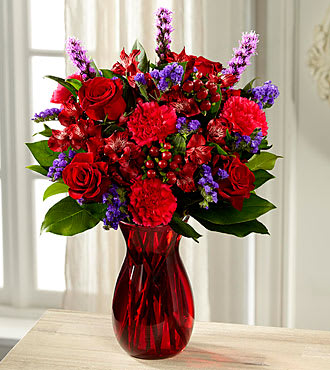
The Love is Grand Bouquet from Bloom Central is an exquisite floral arrangement that will make any recipient feel loved and appreciated. Bursting with vibrant colors and delicate blooms, this bouquet is a true showstopper.
With a combination of beautiful red roses, red Peruvian Lilies, hot pink carnations, purple statice, red hypericum berries and liatris, the Love is Grand Bouquet embodies pure happiness. Bursting with love from every bloom, this bouquet is elegantly arranged in a ruby red glass vase to create an impactive visual affect.
One thing that stands out about this arrangement is the balance. Each flower has been thoughtfully selected to complement one another, creating an aesthetically pleasing harmony of colors and shapes.
Another aspect we can't overlook is the fragrance. The Love is Grand Bouquet emits such a delightful scent that fills up any room it graces with its presence. Imagine walking into your living room after a long day at work and being greeted by this wonderful aroma - instant relaxation!
What really sets this bouquet apart from others are the emotions it evokes. Just looking at it conjures feelings of love, appreciation, and warmth within you.
Not only does this arrangement make an excellent gift for special occasions like birthdays or anniversaries but also serves as a meaningful surprise gift just because Who wouldn't want to receive such beauty unexpectedly?
So go ahead and surprise someone you care about with the Love is Grand Bouquet. This arrangement is a beautiful way to express your emotions and remember, love is grand - so let it bloom!
Whiting Wisconsin Flower Delivery
Whiting Flower Delivery - Frequently Asked Questions
- Does Bloom Central offer same-day flower delivery in Whiting?
- Yes. Place your order online before 1:00 PM and a local Whiting florist will hand-deliver your arrangement the same day. Orders can also be scheduled up to one month in advance.
- Is it safe to order flowers online?
- Absolutely! We utilize a secure, encrypted checkout to protect your personal and payment information. Visa, Mastercard, American Express, Discover, PayPal and Klarna are all accepted.
- What funeral homes does Bloom Central deliver sympathy flowers to in Whiting?
- We hand-deliver sympathy and memorial floral arrangements to all funeral homes near Whiting, including: Beil-Didier Funeral Home, Boston Funeral Home, Brainard Funeral Home, Hansen-Schilling Funeral Home, Helke Funeral Home & Cremation Service, Maple Crest Funeral Home, Shuda Funeral Home Crematory.
- What nearby cities does Bloom Central also deliver flowers to?
- In addition to Whiting, we deliver fresh flowers to many nearby cities including: Stevens Point, Plover, Hull, Linwood, Stockton, Carson, Dewey, Rudolph
- What are the most popular flower arrangements at the Whiting florist?
- Three of our most popular arrangements at our Whiting florist are: Beautiful Horizons Floor Basket ($134.90), Cheers to You Bouquet ($54.90), Fiesta Bouquet Set of 3 ($209.90). All are available for same-day delivery.
More About Whiting
Are looking for a Whiting florist because you are not local to the area? If so, here is a brief travelogue of what Whiting has to offer. Who knows, perhaps you'll be intrigued enough to come visit soon, partake in some of the fun activities Whiting has to offer and deliver flowers to your loved one in person!
In the early morning, when mist still clings to the Chippewa River like a shy child to its mother’s leg, the town of Whiting, Wisconsin, begins to stir. The sun casts a weak, gold light over rows of clapboard houses, their paint chipped just enough to suggest not neglect but endurance, a kind of Midwestern stoicism baked into the eaves. At the intersection of Main and Third, where the traffic light blinks red in all directions, a man in a plaid jacket sweeps the sidewalk outside the hardware store. His broom’s bristles scratch the concrete in a rhythm so steady it could sync with the heartbeat of anyone who pauses to listen. This is not a place that announces itself. It earns your attention slowly, through details: the smell of fresh-cut grass mingling with diesel from a pickup idling outside the diner, the distant laughter of kids pedal-hard down Maple Street, the way the postmaster knows every name on every parcel without checking the label.
Drive through Whiting too fast, say, on your way to someplace louder, brighter, more obviously important, and you might miss it. But stop. Park near the riverbank, where the water moves with the quiet confidence of something that knows where it’s going. Watch the old railroad bridge, its iron bones rusted to a burnt umber, and you’ll see swallows dart through its trusses, stitching the sky. Talk to the woman who runs the bait shop, her hands nicked from rigging lures, and she’ll tell you about the smallmouth bass that school beneath the current, about the teenagers who cast lines at dusk, their voices carrying over the water like secrets. It’s tempting to think of towns like this as relics, holdouts against a world that spins faster each year. But Whiting doesn’t resist modernity. It absorbs what it needs, a new solar panel on the school roof, a Wi-Fi router in the library, and lets the rest slide by, like water off a duck’s back.

Same day service available. Order your Whiting floral delivery and surprise someone today!
What defines Whiting isn’t nostalgia. It’s the way life here insists on tangibility. At the high school football field on Friday nights, you feel the crunch of gravel underfoot, hear the brass band tuning up, taste the tang of popcorn butter in the air. You watch fathers hoist toddlers onto their shoulders, their faces lit by stadium lights, and recognize a thread that connects generations. The grocer bags produce in paper, asks about your aunt’s hip surgery, hands your kid a free apple. The librarian waves you down on the street to say the book you requested just came in. These interactions aren’t quaint. They’re deliberate, a kind of covenant.
By afternoon, when the sun hangs high and the river glints like a seam of quartz, the town seems to exhale. Retirees play chess in the park, moving pawns with hands that once baled hay or welded steel. A teacher walks her class to the dock to drop water samples into glass jars, their faces sharp with focus. Somewhere, a lawnmower coughs to life. There’s a particular grace in the way Whiting embraces repetition, the daily rituals, the seasonal rhythms, without succumbing to monotony. Each repetition is a choice, a vote cast for continuity.
Come evening, the sky softens to lavender. Porch lights flicker on. A group of cyclists coasts down Main, their tires hissing on fresh pavement. At the edge of town, where the fields stretch out in green waves, fireflies rise like sparks from a campfire. You could mistake this for simplicity. But simplicity implies something accidental, unconsidered. Whiting is something rarer: a community that has decided, again and again, to be a community. Not perfect, not static, but present. Alive. The stars here aren’t brighter than elsewhere. They just seem closer, as if the sky itself has settled in to listen.