





- Get Well
- Best Sellers
- Sympathy
 $54.90
- $54.90
- $79.90
- $54.90
- $49.90
- $49.90








- $297.90
- $64.90





July 1, 2026
Ogden July Floral Selection
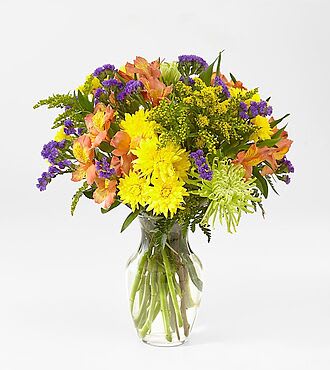
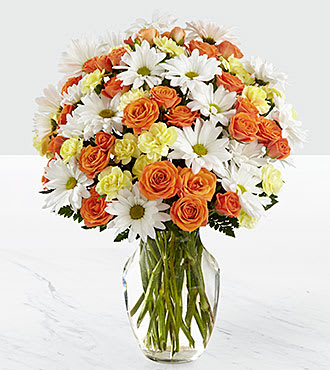
The Bloom Central flower delivery of the month for July in Ogden is the Light and Lovely Bouquet
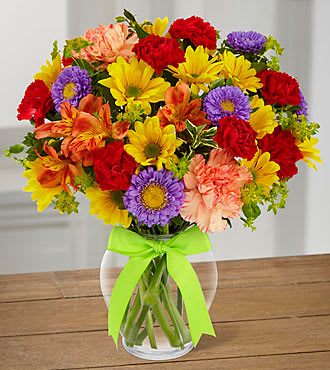
Introducing the Light and Lovely Bouquet, a floral arrangement that will brighten up any space with its delicate beauty. This charming bouquet, available at Bloom Central, exudes a sense of freshness and joy that will make you smile from ear to ear.
The Light and Lovely Bouquet features an enchanting combination of yellow daisies, orange Peruvian Lilies, lavender matsumoto asters, orange carnations and red mini carnations. These lovely blooms are carefully arranged in a clear glass vase with a touch of greenery for added elegance.
This delightful floral bouquet is perfect for all occasions be it welcoming a new baby into the world or expressing heartfelt gratitude to someone special. The simplicity and pops of color make this arrangement suitable for anyone who appreciates beauty in its purest form.
What is truly remarkable about the Light and Lovely Bouquet is how effortlessly it brings warmth into any room. It adds just the right amount of charm without overwhelming the senses.
The Light and Lovely Bouquet also comes arranged beautifully in a clear glass vase tied with a lime green ribbon at the neck - making it an ideal gift option when you want to convey your love or appreciation.
Another wonderful aspect worth mentioning is how long-lasting these blooms can be if properly cared for. With regular watering and trimming stems every few days along with fresh water changes every other day; this bouquet can continue bringing cheerfulness for up to two weeks.
There is simply no denying the sheer loveliness radiating from within this exquisite floral arrangement offered by the Light and Lovely Bouquet. The gentle colors combined with thoughtful design make it an absolute must-have addition to any home or a delightful gift to brighten someone's day. Order yours today and experience the joy it brings firsthand.
Local Flower Delivery in Ogden
Ogden Flower Delivery - Frequently Asked Questions
- Does Bloom Central offer same-day flower delivery in Ogden?
- Yes. Place your order online before 1:00 PM and a local Ogden florist will hand-deliver your arrangement the same day. Orders can also be scheduled up to one month in advance.
- Is it safe to order flowers online?
- Absolutely! We utilize a secure, encrypted checkout to protect your personal and payment information. Visa, Mastercard, American Express, Discover, PayPal and Klarna are all accepted.
- What funeral homes does Bloom Central deliver sympathy flowers to in Ogden?
- We hand-deliver sympathy and memorial floral arrangements to all funeral homes near Ogden, including: Irvin-Parkview Funeral Home.
- What nearby cities does Bloom Central also deliver flowers to?
- In addition to Ogden, we deliver fresh flowers to many nearby cities including: Manhattan, Fort Riley, Grandview Plaza, Madison, Jefferson, Junction City, Milford, Smoky Hill
- What are the most popular flower arrangements at the Ogden florist?
- Three of our most popular arrangements at our Ogden florist are: String of Pearls Bouquet ($64.90), Love is Grand Bouquet ($79.90), Precious Petals Bouquet ($54.90). All are available for same-day delivery.
More About Ogden
Are looking for a Ogden florist because you are not local to the area? If so, here is a brief travelogue of what Ogden has to offer. Who knows, perhaps you'll be intrigued enough to come visit soon, partake in some of the fun activities Ogden has to offer and deliver flowers to your loved one in person!
Ogden, Kansas, sits where the plains decide to fold into something like a shrug, a modest dip in the earth’s patience, a place where the sky seems less a ceiling than a colloquium of light. To drive into Ogden is to enter a town that has not so much resisted time as nodded at it, politely, and continued planting marigolds. The streets here are named after trees that no longer stand where they were planted, but the irony feels gentle, even affectionate. Locals wave at unfamiliar cars not out of obligation but a kind of shared rhythm, a recognition that movement through space requires witnesses.
The heart of Ogden beats in its post office, a squat brick building where Mrs. Lorna Greeley has sorted mail for thirty-four years. She knows which boxes receive handwritten letters and which ones get catalogs, which families send care packages to college freshmen who text home about cafeteria food. The post office doubles as an informal town square, a spot where retirees debate the merits of hybrid tomatoes and children clutch popsicles while their mothers trade zucchini bread recipes. Across the street, the diner’s screen door announces each entrance with a slap, and the coffee tastes like something brewed by a neighbor who remembers your name.

Same day service available. Order your Ogden floral delivery and surprise someone today!
Train tracks bisect the town, a steel zipper that once connected cattle and grain to the pulse of the continent. The trains still come, hauling their anonymous cargo, but they slow here, as if the engineers sense the collective pause of a community that still looks up at the sound. Kids count boxcars on their fingers; old men nod at the conductor’s wave. The tracks are both boundary and lifeline, a reminder that Ogden exists because something once needed to pass through it, and chose, against logic, to stay.
Summer afternoons pool like honey under the elms of City Park, where teenagers dare each other to cannonball into the pool and octogenarians play chess with pieces carved by a high school shop class. The library, a converted Victorian home, smells of paperbacks and lemon polish. Miss Edna, the librarian, recommends detective novels to third graders and books on astrophysics to farmers, insisting that curiosity is a crop best harvested daily. Down the block, the hardware store’s owner, Bud, can tell you which hinge will quiet a squeaky door and which fertilizer will coax roses from Kansas clay. His advice is free, but the real currency is the way he leans on the counter, grinning, as if every problem has a solution that starts with a conversation.
Autumn brings the Harvest Festival, a parade of tractors polished to blinding sheens, floats constructed from chicken wire and tissue paper, and a brass band that plays slightly off-key, as though the music itself is laughing. The entire town gathers, not out of nostalgia but because gathering is what turns a crowd into a chorus. Winter hushes the streets but amplifies the glow of porch lights left on for late-shift teachers and nurses. Snow muffles the roads, and the church bells ring clearer, their sound sharp enough to cut through frost.
To outsiders, Ogden might seem a fossil, a holdout from an America that exists mostly in black-and-white photos. But fossil implies lifelessness, and Ogden’s pulse is steady, insistent. The town thrives not in spite of its smallness but because of it. Every sidewalk crack is mapped in someone’s memory; every front yard hosts a saga of birthdays and badminton games. Here, the extraordinary lives in the ordinary, the way a waitress remembers your order, the way dusk turns wheat fields into bronze waves, the way a place can become both compass and anchor. Ogden does not dazzle. It endures, and in enduring, it invites you to consider what lasts.